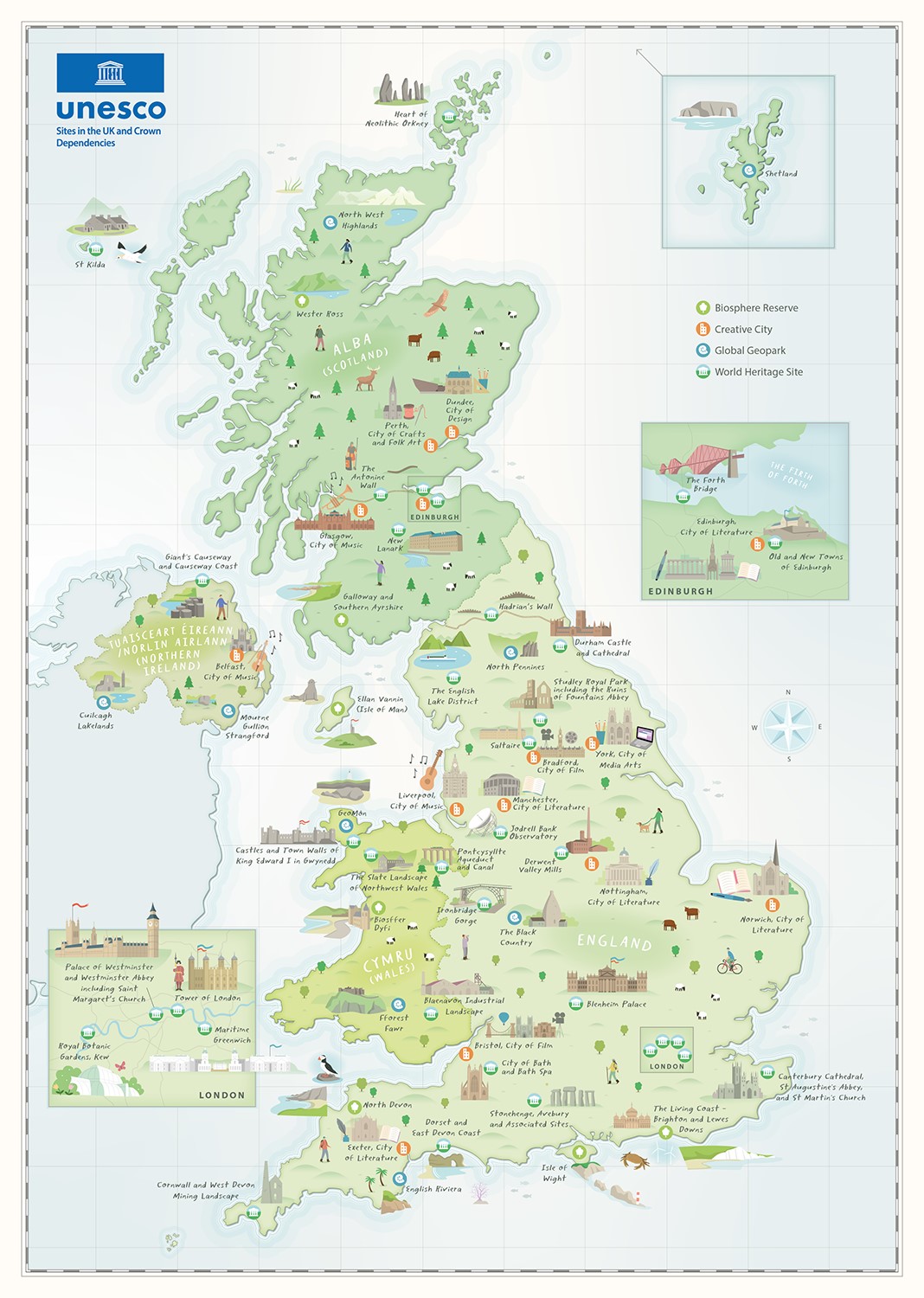
The Creative Cities Living Heritage Residency Programme is a new micro-residency programme designed to celebrate and strengthen the cultural and natural connections between Scotland’s UNESCO Sites. This initiative will bring together Scotland’s four UNESCO Creative Cities, Edinburgh (Literature), Glasgow (Music), Dundee (Design), and Perth (Crafts & Folk Art), with other UNESCO sites across Scotland. The programme will create a platform for artistic exchange and collaboration.
Over the course of up to one week, each selected artist will be immersed in one of these paired locations, engaging deeply with the unique cultural and environmental character of their residency site.
The creative collaborations are as follows:
A designer from Dundee (UNESCO City of Design) will be working with New Lanark, a UNESCO World Heritage Site.
New Lanark is an 18th-century mill village and UNESCO World Heritage Site on the banks of the River Clyde. Founded by David Dale in 1785 and later owned by Robert Owen, it became renowned for its forward-thinking, utopian model, featuring well-designed workers’ housing, progressive factory reform, and pioneering education. Widely regarded as one of the most innovative early industrial communities, New Lanark is now a charitable Trust that continues to preserve its unique heritage, educate learners, and engage visitors from around the world.
Dundee is the UK’s first and only UNESCO City of Design. The global designation as a Creative City acknowledges Dundee’s rich design heritage, its thriving contemporary design sector and a city committed to using design to solve problems and make Dundee a better place to live.
This residency will bring together the design innovation of Dundee with the pioneering model of New Lanark to look at how heritage models can influence contemporary design.
A writer from Edinburgh (UNESCO City of Literature) will be will be working with The Forth Bridge, a World Heritage Site.
Recognised the world over, the Forth Bridge is a true Scottish icon symbolising engineering brilliance and Scottish pride. The world’s first major steel edifice remains a potent symbol of Britain’s industrial, scientific, architectural and transport heritage. The distinctive red bridge carries around 200 trains across the Forth every day.
Edinburgh was designated the world’s first UNESCO City of Literature, being the founding city in an international network of UNESCO Cities of Literature. Over 20 years, the trust have helped grow a global network of international literary cities, for the benefit of writers and literature professionals, bringing opportunities for paid commissions, supporting their creative practice and broadening their networks.
This residency will focus on the sites and sounds of The Forth Bridge.
A musician from Glasgow (UNESCO City of Music) will be working with New Lanark, a UNESCO World Heritage Site.
New Lanark is an 18th-century mill village and UNESCO World Heritage Site on the banks of the River Clyde. Founded by David Dale in 1785 and later owned by Robert Owen, it became renowned for its forward-thinking, utopian model, featuring well-designed workers’ housing, progressive factory reform, and pioneering education. Widely regarded as one of the most innovative early industrial communities, New Lanark is now a charitable Trust that continues to preserve its unique heritage, educate learners, and engage visitors from around the world.
Glasgow was named the UK’s first UNESCO City of Music and only the third in the world in August 2008. The network places Glasgow’s music on a global stage and at the heart of international music discussion, advocacy and promotion.
This residency will focus on the contemporary sounds of a heritage utopia.
A craft maker from Perth & Kinross (UNESCO City of Craft & Folk Art) will be working with Arran Geopark, a UNESCO Global Geopark.
The Isle of Arran is known as ‘Scotland in Miniature’, sitting astride a major fault that once divided continents; it showcases many events in Scotland’s geological history. Arran’s extraordinary geodiversity is the driver for its unique biotic and cultural heritage. This distinctive place has been an inspiration for generations of iconic artists, captivated by the ever-changing light, colours and sounds.
Craft is an integral part of this area’s history. Medieval Perth was a centre of craft production and trade. By the early 1500s, Perth was known as a ‘craftis toun’. This reputation has been maintained throughout the centuries, and today there is still a thriving and reputable Craft and Folk Art sector.
This residency will focus on craft links in the shared geology of Arran and Perthshire.
The UK National Commission for UNESCO launched the ‘Local to Global UNESCO Network Community Grants’ open call for UNESCO Sites in the UK. The grants have been made available with support from the National Lottery Heritage Fund, thanks to National Lottery players.
Ask: Each artist will be tasked with creating one piece of creative work that reflects and responds to the distinctive qualities of their residency location, whether through sound, image, word, or form. These works will be shared online through blog posts, photography, video or in another way appropriate to the artists creative practice.
Eligibility: you are only eligible to apply for the residency for the area you are based, e.g. if you are a musician based in Dundee, you cannot apply for the Glasgow City of Music residency, etc.
Fees: each micro-residency will include 5x day rates at Scottish Artist Union Rates, totalling £1796. This can be 5 full working days, 10 half days, etc. There will be £150 for travel, and an additional £154 available for access and material costs. Accommodation will be provided and arranged in discussion with the successful creatives. Support for this project is provided in-kind from Scotland’s UNESCO Creative Cities, the residency host sites, and supporting partners.
Timeline: All residencies will take place between May-June 2026, with all being complete by 30 June 2026.
Deadline for applications is 1pm, 13 April 2026. We will aim to respond to applications by 21 April, but this may be delayed due to unforeseen circumstances. If you are selected, you may be asked for a preliminary meeting.